madinamerica
J.A. Carter-Winward

The pain assessment chart. We’ve all seen it on the wall in the ER, the doctor’s office.
I remember laughing at it when I first saw it in the local pain clinic in October of 2017. I’d gone in to get deep Botox injections in my neck — 24 of them — for my seized neck muscles, one of the many neurological conditions caused by psychiatric medications.
It was October 2017, and I’d been off the offending medication, Latuda, for over a year. Latuda is one of many “new generation” atypical antipsychotics that, once upon a time, were only given to the “severely mentally ill.” Atypical antipsychotics were FDA-approved for bipolar disorder, bipolar depression, treatment-resistant depression, and unipolar depression. They are also routinely prescribed by all manner of physicians to treat insomnia, postpartum depression, PTSD, and other mental and physiological disorders.
I pointed to the pain scale and said to my husband, “I wish ‘10’ and ‘bed rest required’ was my ‘worst possible pain.’” He agreed. I looked at the pain scale in the pain clinic with no small amount of anger and feelings of loss and betrayal because by that time, I’d been to see four doctors — three neurologists and one ER doctor — all of whom didn’t, and don’t, believe I was in pain when I came in to see them.
Which, looking back, seems odd to me. They (doctors) believed me when, in the 1990s, a CT scan showed I’d sustained a concussion and whiplash after being violently assaulted. They believed me when I presented with all the symptoms of a traumatic brain injury (TBI) and was experiencing depression as well as cognitive difficulties — things I’d never before struggled with — consistent with a TBI, such as a substantial loss of executive functioning. They believed me when I said I felt myself heading for a brick wall physically and emotionally. They took my word for it and gave me more and more medications to try to stop the collision.
Fast-forward years later:
In 2016, after years of suffering with an extrapyramidal side effect caused by the medications they gave me beginning in 2004, I told these three neurologists and the ER doctor the name of my suffering: akathisia. The bastard child of psychiatric medications that no one wants to claim. I knew the name because my former psychiatrist and neuropsychologist diagnosed me and told me to see a neurologist. They took one look at me and all but ordered me to the ER. They assured me the physician there would admit me, and I’d get a full neurological workup. I didn’t want to go, even though I finally knew why I was feeling this pain. A drug side effect? Unbelievable.
I couldn’t believe a medication could cause something so completely disabling — a pain that blurred the lines between emotional and physical: the type of pain you feel when you can’t eat after a horrific loss or trauma. Pain that ground inside me every day, without a reprieve. How bad is the pain? The following is a short YouTube film I wrote and produced. It shows you just how bad the daily pain can be. And how the “good” medications we’re given caused it.
I’d been told it was my “illness,” so I battled shame, guilt, and daily thoughts of ending my own life due to how agonizing it had become. The pain seemed to center right in my solar plexus, and it was so unrelenting, I was almost entirely homebound. My career as a public figure dwindled to a whisper. My world, our world, had shrunk from a panoramic window of infinite possibility and adventure to a peephole.
The Pain, as I called it, was not depression, not anxiety, and it wasn’t a worsening of an underlying mental illness, as I’d been told. I’d been treated successfully with talk therapy for depression as a teen. I knew “depression.” I’d had some anxiety and knew how to deal with that well enough. But when I began taking antipsychotics, the pain I experienced was something else altogether, and I knew it.
“Akathisia: restlessness and feeling like you can’t sit still, right?” Not quite. Not entirely. That’s like saying “Ah, cancer. So, losing some weight, are you?”
But when I told these four doctors I had drug-induced akathisia, and it was tardive, acute, chronic, and getting worse — when I told them how akathisia presented in me and for me subjectively, because there is a “subjective component” of akathisia that’s been documented, which all four acknowledged…
They did not and do not believe me.
I’m not even sure my current doctors believe me. I think they believe *I* believe I am experiencing “real or perceived pain.” But they don’t fully believe it’s the neurological movement disorder, akathisia. This begs the question:
When did my credibility suddenly disappear? And why?
It’s simple, really. I lost credibility when they misdiagnosed me in the 1990s with a mental illness after I sustained the TBI. In other words: They stopped believing me when I chose to believe them.
* * *
When they ignored the classic TBI symptoms with which I presented at the county-run, sliding-fee mental health facility back in 1996, the only care I could afford with no insurance, they went with the easier diagnosis: “bipolar disorder.” The other obvious issues I faced didn’t fit their categories.
I couldn’t google symptoms of a brain injury in 1996, and I had no financial help. All I had was implicit trust in doctors, something my parents handed down to all of us, and why I have a disproportionate number of doctors in my family, I’d wager. In the world in which my parents had grown up, doctors were akin to clergy: sacrosanct, and impervious to baser human frailties.
They asked me questions at the mental health clinic, and I offered up the other symptoms that had caused me to lose jobs, and flunk out of college because my professors suddenly spoke in “word salads.” Panic gripped me as I watched my once off-the-charts reading comprehension dissolve into an inability to follow a simple cake recipe. But they didn’t want to hear about those symptoms. Instead, they misdiagnosed me, and I believed them, because they were supposed to know more than I did.
In the last 2+ years, I’ve been searching for help, specifically from neurologists, since “neurological” is right there in my diagnoses. I have what is called DIMDs, or drug-induced movement disorders, and they are neurological. Most recently, my dystonia has advanced. It is now beginning to affect not only my ability to swallow, it has progressed to the point where my respiratory muscles can, and have, seized up. When this happens, I cannot breathe. I literally feel as though I’m suffocating. And as it progresses? I could.
But I no longer feel safe going to a new doctor, nor the hospital. That’s because the three neurologists and one ER doctor we saw told us, and wrote in their clinical notes, that I am psychosomatically ill.
Each doctor wrote in my chart, to be seen by every healthcare provider I see “in-network,” that I have Conversion Disorder, now known as FND — functional neurological disorder — and that I should be evaluated by a mental healthcare professional/specialist.
They all said that the subjective “pain” caused by akathisia, the pain I experience, is not neurological. Doesn’t “subjective” mean it’s different for everyone? Yet their unilateral diagnoses, which relied on my health history and their clinical, subjective opinions, have been validated by their white coats.
Further, two of the neurologists suggested that I had features of a Cluster B Personality Disorder. In case you’re not familiar, these include Borderline, Histrionic, Narcissistic, and Antisocial Personality Disorder. The Cluster B’s are characterized by emotional instability, cries for attention, unstable self-concept, and by being overly dramatic, pathologically dishonest, manipulative, and lacking empathy for others, among other “features.” In other words, the neurologists all concur that I am the most unreliable “narrator” of my own subjective experience and pain.
One neurologist, who seemed extremely hyper-focused on my need to see a “mental health specialist,” wrote that I should be evaluated specifically for Borderline Personality Disorder. Because they are not “mental healthcare specialists,” they are not qualified to diagnose me themselves, despite obliquely doing exactly that.
After they all cast doubt on the reality of my pain with what they wrote in my chart, they all concurred that I have drug-induced neurological movement disorders: tardive akathisia, dystonia, dyskinesia. They also confirmed the TBI. An MRI of my neck a year ago (before the Botox shots) confirmed the herniated discs in my C-spine, but the injuries were not new. Had I been in a car accident 20+ years ago? asked the pain-clinic doctor.
But what the neurologists categorically deny is that akathisia is “painful” — specifically, “subjectively, emotionally painful.”
One neurologist, the second one I saw, wrote a redundant narrative throughout my chart about my emotional “instability,” and suggested the BPD “evaluation.” Usually it takes a while for even a therapist to make that call. He diagnosed it, wrote it in my chart, despite the fact that he knew I am currently in therapy and have been most of my adult life, due to the trauma of sustaining a TBI in a violent assault, but also dealing with what we now know to be the direct result of iatrogenic harm.
Yet, he told us akathisia does not cause feelings so painful that they can lead to suicide.
“Sure. Akathisia does cause some ‘restlessness’ and that can be ‘uncomfortable…’ but akathisia is a motor dysfunction characterized by… and it does not ‘cause’ suicidal feelings…”
The pain of akathisia is worse than anything I’ve ever experienced in my life. I’d rather go through natural childbirth, daily. Yet Dr. “Uncomfortable” then told me my movements weren’t “consistent with akathisia presentation.” He proceeded to dance like a belly dancer in his chair, “showing” us what akathisia looks like. We left, and I was in tears. I was worried that perhaps I was mentally unstable. He gave us patient handouts about akathisia. Dr. Uncomfortable showed us an adorable belly-dance routine while my body shook and jittered exactly as his patient handout described.
My account was the same as I spoke to these doctors, varying only a little, because how does one purport to describe the indescribable? I’m a writer by trade, so, I used my skills to convey the pain of the persisting akathisia to each doctor and neurologist this way:
Take every horrific feeling you’ve ever had in your life, all at once. Now, times them by 200, right in your gut. The “my-mother-just- died-and-so-did-my-cat-and-my-wife-left-me-for-my-best-friend” feeling. On top of those? A feeling of terror, panic, fear, as if you LIVE in a horror movie, and you must do something, or everyone you love will die, YOU will die — and you’ve no clue what that “something” is. So sick with this pain, caused by this neurological condition… so sick from it you can barely eat. That is how akathisia pain feels. It’s how it feels to me, and countless others who are experiencing it, or who have.
And they have all methodically undermined my credibility in my permanent record — a medical maligning that could cost me my life.
Because if it’s emotional, then it’s my fault. My problem. My issue. When, in fact, my symptoms were not present before they gave me the medications in the first place. Hardly a causal link in the world of science. But when I walked into their offices? I was not suicidal.
Yet, all I had to do was tell them I was in emotional pain when I walked into the doctor’s offices in the 90’s, then again in 2004, and they believed me enough to give me dopamine-altering medications that can, and have, caused permanent damage to my brain.
And this is because they do not know, and rather than admit that, they dispute my subjective experience, and the experience of countless others, and add “mental health” determinations they are not qualified to make based on less than 30 minutes of face-time. A personality disorder. And according to their criteria and the general definition of Cluster B Personality Disorder they adhere to from the DSM-5, symptoms must:
not be due to another disorder
not be due to an isolated stressful situation
Well, they’re right about one thing: It isn’t due to only one, isolated stressful situation — not anymore. The TBI from having my head bashed into a car by someone I once trusted? That was only the first of many blows to come.
The first neurologist I saw in Salt Lake City is a specialist in movement disorders. After telling me there was no viable treatment for them, specifically akathisia, she went on to write this characterization of akathisia and its subjective component:
“Tardive akathisia . . . most often associated with antipsychotic drugs, which antagonize dopamine receptors. The subjective component can be characterized by the aforementioned restlessness, as well as tension, panic, irritability and impatience.”
Along with this, she wrote her impressions of me, impressions that seem particularly callous and paradoxical, given her diagnoses:
“PHYSICAL EXAMINATION: General. Extremely frustrated, anxious and at times tearful woman.”
Two weeks prior to seeing her, I had lost my ability to walk normally, had begun to move involuntarily, was developing aphasia (an inability to understand or express speech), and let’s not forget The Pain — akathisia — a pain so horrific I wanted to die to escape it.
Yes, when she told us she had nothing to offer, I was upset, emotional, and began to sob in the exam room. With no answers, no hope in sight, I behaved exactly how a person who had sustained a TBI would behave; exactly how someone who suffered from the neurological disorders each doctor diagnosed me with (including rapid-onset dystonia) would behave. According to the Dystonia Medical Research Foundation’s website:
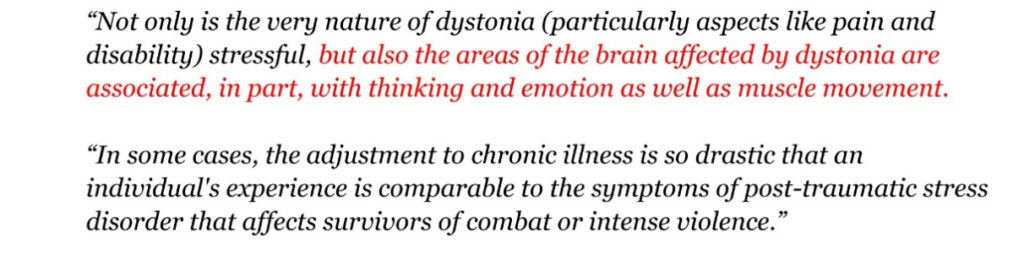
Finally, I behaved exactly how any human being would behave and react when told there is no treatment, no cure, no hope, and that her pain is not real, not physiological, but an emotional and mental health issue.
My brain injury has impacted me for over 20+ years, and I did not know it. I had suffered from drug-induced akathisia for 12+ years and did not know it. My dopamine has been dysregulated by medications, and yet they told me that akathisia could not cause subjective emotional pain, despite the role dopamine plays in our brains’ control centers for all our physiology — including our emotional states.
And if I suddenly can’t breathe due to a dystonic seizure of my respiratory muscles again, and it’s worse than the last attack? I can’t call for help. Even if I make it to the ER, it’s possible a nurse or doctor there will read through my chart and see, hidden in the medical language of those who have made their arbitrary dismissals: “Unstable, unsound. Don’t believe her.” And as I slowly suffocate, they could very well pat me on the head and tell me to calm down while they go find a sugar pill.
Well, at least a sugar pill won’t make my akathisia worse.
The article on “Talking to Your Doctor About Pain” that arrived in my Inbox the other morning made me bark a laughter as bitter as my chicory-laced coffee. It suggested that we don’t “shy away from ‘flowery language’ to describe [our] pain.” Flowery language? I’ve written a whole book of flowery language: flowery, plain, in-your-face-obscene language, medically accurate and appropriate language, all describing akathisia pain. I tried flowery. But my doctors didn’t hear it. They searched for categories in which to place me. And they’ve succeeded.
After the premier of my “How Bad Can Good Be” video, messages and emails came pouring into our site’s contact form (akathisia.life — the website my husband put up to help bring awareness to those who don’t have the resources we do). The messages all had horror stories, more horrific even than mine, and the single, common thread within the messages, from those who are suffering with akathisia:
“Thank you for writing the feelings I couldn’t express and conveying the horror I feel every day.”
My film has been shared on social media (it now has over 10k views on Facebook alone), and one chilling tagline was simple, and terrible, in its implications:
“It has a name.”
And now it also has a face. To capture the horrifying pain of akathisia, I created a painting with charcoal and photo collage:

“Akathisia: It Has a Name,” photo collage and charcoal by J.A. Carter-Winward
This is my worst pain, far beyond “bed rest required.” Tell me, does the image above convey simply “uncomfortable” to you?
I’m going on 14+ years now with drug-induced, now tardive, chronic akathisia. As I’ve searched for a neurologist to be on my “care team” to help me deal with the drug-induced movement disorders, specifically help with ways to deal with the progression of drug-induced dystonia, they brush me off.
More to the point, they brush akathisia off. “Uncomfortable,” remember? Not so painful you want to end your life. Not so horrific you might take someone else’s with you to the other side. No. Uncomfortable.
If I were as “emotionally unsound” as they say in my medical chart, I’d say it’s almost like they want me to end my life, so they can write it off as “another tragic suicide caused by mental illness.”
Only, I’m not mentally ill, based on their own criteria. The only mental health issues with which I currently deal? The trauma of iatrogenesis and living, every day, with these conditions created by medications as I fight for my life.
Sorry, Doctor Uncomfortable and Co. I’m not going anywhere. And your patients? We are reading the same studies as you — and more. Because your motivation is to keep the status quo, aka your jobs, your relevance, your authority. So, you will only seek out studies that support what you believe. Call it confirmation bias, call it professional and publication bias, it’s all the same stuff. Our motivation? We want you to hear us, help us, and tell us what we do NOT know. Admit what you cannot do, and then do your jobs. HEAL. You broke it: fix it. And only pressure from you, the “dealers,” will change the way pharmaceutical companies create and market medications.
Our pain is real. And too many medical professionals have actually caused it by their willful ignorance, coupled with blind, medical arrogance. Yes, it takes two to form a lie: we are complicit. We want professionals to have the answers, so we give them the answers they need to give us our labels, medicate us, so we can go on with our lives. But the lies are killing us.
And when we begin trusting ourselves, and arming ourselves with the facts and studies coming out of Europe (the more-evolved cluster of First-World countries who provide universal healthcare to their citizenry), we will defer to them, because they are not motivated by the greed that riddles the polluted, crooked, for-profit healthcare system in the U.S.
For any of you who have taken medications that cause akathisia, arm yourselves with facts. You can google. Look it up. You’ll officially know more than most neurologists.
Watch my video. Look at the website for akathisia info. Read Robert Whitaker’s book, Mad in America, and the others out there who are trying to wake you up. We are trying to save your lives.
Then share what you learn like your life depends on it.
Because statistically… someone’s life does.
And yes, it will be uncomfortable. Challenging accepted wisdom usually is.
But look into the “face” of that pain, above. I promise you: Confronting your doctor with your truth isn’t nearly as “uncomfortable” as a pain that invades your entire being, finds every soft and vulnerable place within you, and rips it out with its teeth as you watch in horror…
Because “it” isn’t holding the gun to your head, or stringing the rope up in the rafters:
It’s you.
Flowery enough for you?
Previous articleTrauma Outside the Box: How the ‘Trauma-Informed’ Trend Falls Short
Next articleStudy Finds Deteriorating Mental Health Among Poor White Americans
J.A. Carter-Winward
https://www.jacarterwinward.com/akathisia
J.A. Carter-Winward is an award-winning poet, literary novelist, playwright, performer, and visual artist. Through 14 years of drug-induced akathisia, she authored 13 books. Off the medications seven months, she developed a cluster of neurological movement disorders that impact every facet of her life as a writer, public figure, and human being. Her upcoming collection, in-her-rest-less-ness: prose and poems, is a chronicle spanning 14+ years, written before she knew her suffering had a name.
Thank You Ms Carter-Winward and MIA.


